
Parents often want to know whether Islamic lessons are working, but progress is broader than the number of pages completed. A child may be improving pronunciation, remembering class routines, asking better questions, or becoming more confident in recitation even when the visible syllabus moves slowly.
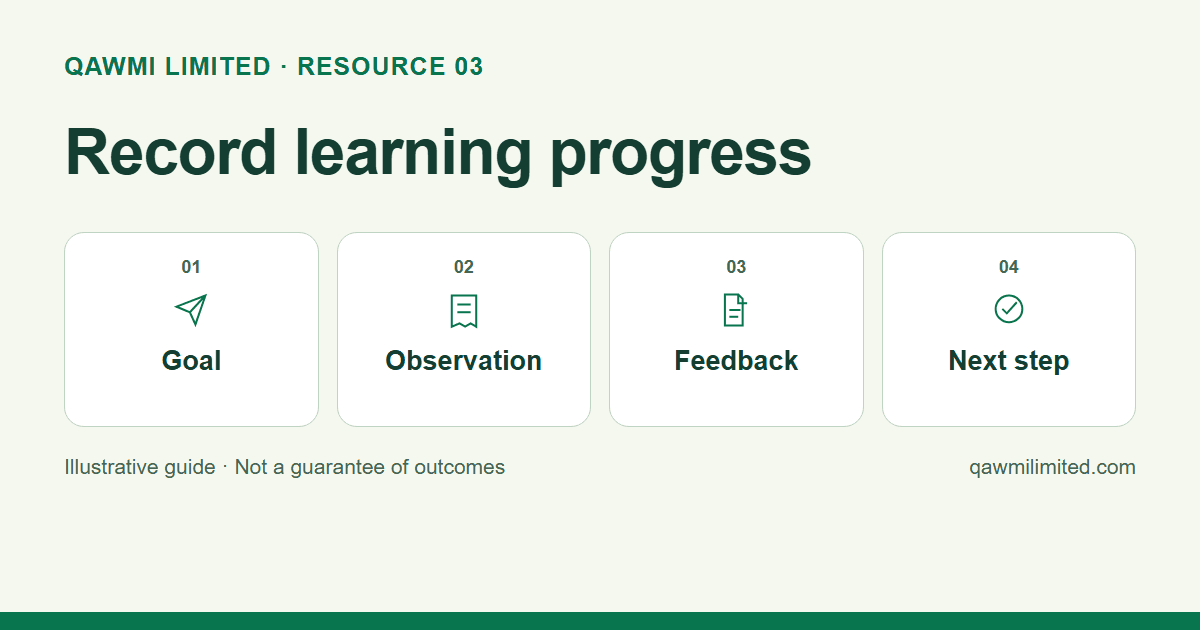
Useful tracking should make the next step clearer for the learner, teacher, and family. It should not create a second classroom at home or reduce worship and learning to a score. A small set of consistent observations, discussed regularly with the teacher, can give a more balanced picture.
Agree on a few clear learning goals
Start by asking what the child is expected to learn over the next four to eight weeks. Goals should be specific enough to observe, such as recognising a group of letters, reading a passage with fewer prompts, applying one Tajweed rule, memorising a short surah accurately, or explaining a basic Islamic concept in their own words.
- Write the current level and the next target in simple language.
- Separate skill goals from attendance and practice habits.
- Choose fewer meaningful goals rather than a long checklist.
- Review goals with the teacher when progress stalls or accelerates.
Track consistency before judging outcomes
A learner cannot benefit fully from a good curriculum if classes are frequently missed or practice is unpredictable. Keep a simple monthly record of attendance, punctuality, and assigned practice. The purpose is not to punish the child; it is to identify practical barriers such as an unsuitable time, device problems, unclear homework, or an overloaded family schedule.
- Record completed and missed lessons with a short reason.
- Note whether the agreed practice happened, not how perfect it was.
- Look for patterns by day, time, or activity.
- Change the routine when the evidence shows it is not sustainable.
Use small samples of real performance
Instead of asking only whether a chapter is finished, occasionally listen to a short recitation, ask the child to demonstrate a rule, or invite them to explain what they learned. Compare the child with their own earlier performance. A short dated audio sample, kept privately by the family with the child's knowledge, may help show changes in fluency or accuracy over time.
Ask the teacher focused questions
General questions often produce general answers. A brief monthly conversation becomes more useful when parents ask about one strength, one recurring difficulty, the current priority, and the exact practice expected at home. Parents should also share relevant changes—such as school exams, health, or timetable pressure—that may affect participation.
- What can my child do now that was difficult last month?
- Which mistake or concept needs the most attention next?
- What should we practise, for how long, and how often?
- Is the present lesson pace suitable for the child?
Include confidence, character, and connection
Islamic learning has knowledge and skill goals, but parents may also observe whether the child approaches lessons willingly, handles correction, shows respect for the Quran, and connects learning with daily life. These qualities should not be turned into simplistic grades. They are conversation prompts that help adults notice the emotional and spiritual environment around learning.
Respond to slow progress with curiosity
When progress is slower than expected, first ask why. The starting level may have been inaccurate, the target may be too large, the child may need a different explanation, or the routine may be inconsistent. Speak with the teacher and adjust one factor at a time. Persistent reading, hearing, attention, or developmental concerns may also deserve appropriate professional assessment outside the class.
A practical next step
A useful progress system can fit on one page: current goals, attendance, practice, a short work sample, teacher feedback, and the next action. Review it monthly rather than daily. When tracking is calm and specific, it supports accountability while protecting the child's confidence and helping the family and teacher work as one team.